
Once universally understood to be harmful for human health, saturated fat is now being re-branded as “healthy fat”, at the expense of, well, actually healthy fats.
Lately, I’ve been noticing a troubling shift everywhere from social media to grocery stores where saturated fat sources like beef tallow and coconut oil are being rebranded as “healthy fat”. Meanwhile, chips, cereal, protein bars, and even entire restaurants proudly declare they are “seed oil free”. While the war on seed oils is nothing new, we seem to have entered an entirely new realm of absurdity where saturated fat is actually…good for you?
The term “healthy fat” refers to unsaturated fat which is found in high levels in seeds, nuts, avocados, fatty fish, olives, and cooking oils (that includes seed oils!). In the 1970s and 80s, Americans were (mis)directed to strictly limit total fat intake, despite mounting evidence that the type of fat was far more important than the total amount. The phrase “healthy fat” gained widespread popularity in the 1990s as a way to communicate changing recommendations around dietary fat; namely to limit saturated fat in favor of unsaturated, or “healthy” fat.
But major sources of nutrition misinformation like the Make America Healthy Again (MAHA) movement and social media wellness grifters have now turned this label around, demonizing sources of unsaturated fat and rebranding saturated fat as “healthy”.
Saturated fat is found mainly in animal products with a few plant-based exceptions, like coconut oil. Red meat, especially fatty cuts; rendered fat like tallow and lard; butter; and full-fat dairy contain high amounts of saturated fat.
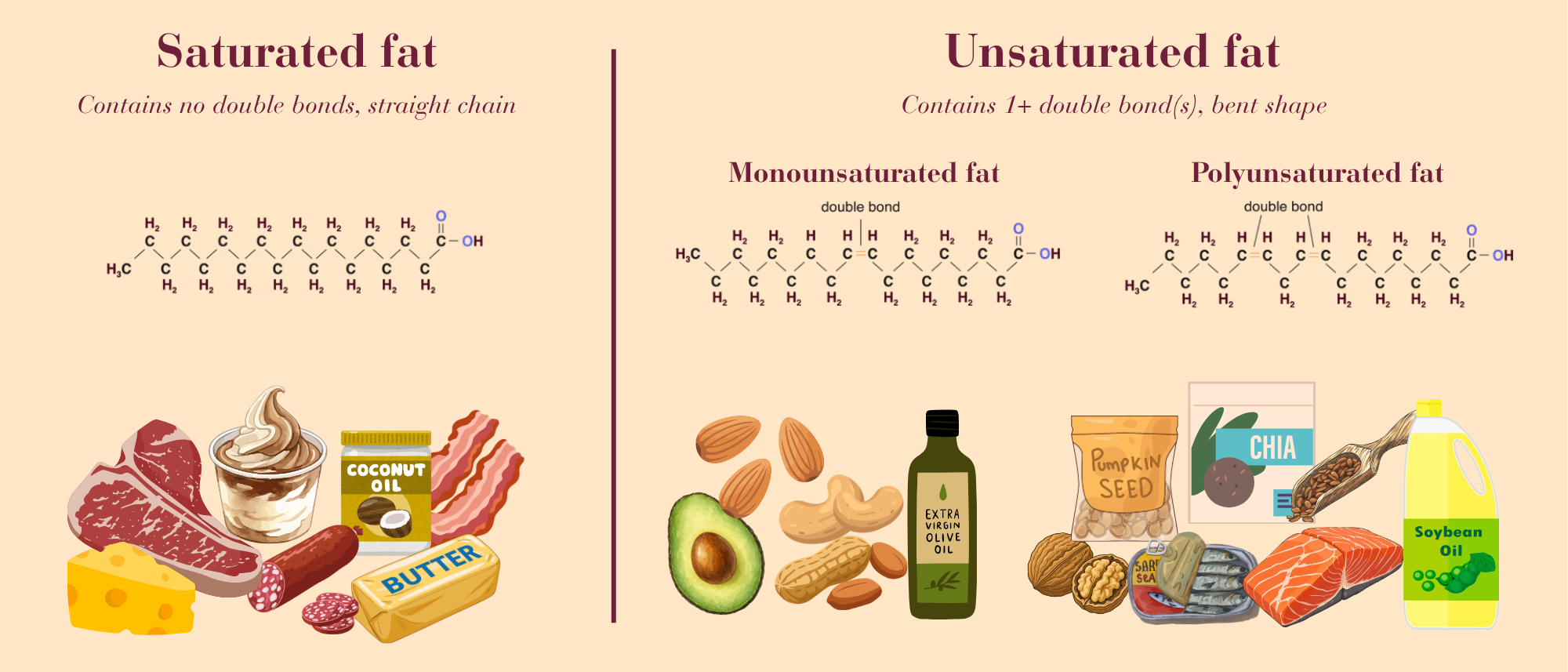
If you’re ever wondering whether something is mostly saturated or unsaturated fat, here’s a good rule of thumb: at room temperature, saturated fat is solid and unsaturated fat is liquid. The one exception is margarine, which is solid at room temperature but mostly unsaturated fat.
This push to re-frame saturated fat as healthy flies in the face of decades of high-quality research that consistently demonstrates health benefits of a diet rich in unsaturated fat and low in saturated fat.
Protection against cardiovascular disease is the most significant and well-studied benefit. High LDL cholesterol is one of the biggest modifiable risk factors for cardiovascular disease. This is because these small cholesterol particles can embed in the walls of blood vessels, where they harden and cause the vessels to narrow. This decreases blood flow to the heart and brain, and significantly increases the risk of strokes and heart attacks.
Diets high in saturated fat have long been known to raise LDL cholesterol. But, replacing it with unsaturated fat can significantly decrease LDL cholesterol and your subsequent risk of heart disease.
One study found that replacing 5% of daily calories from saturated fat with unsaturated fat significantly reduced the risk of heart events, and reduced the risk of a heart-related death by 26% [1].
In individuals at risk of cardiovascular disease, making the same swap for unsaturated fat led to a 33 - 37%* reduced risk of developing cardiovascular disease [2].
Another meta-analysis found that replacing 5% of calories from saturated fat with unsaturated fat reduced the risk of dying from heart disease by 20%. Total mortality (death from any cause) risk also dropped 22%. In addition to cardiovascular and total mortality, this same study also found that swapping saturated fat for unsaturated fat significantly decreased the risk of mortality from neurodegenerative disease by 24% and cancer by 12% [3].
These are just a few examples pulled from the overwhelming body of evidence demonstrating that reducing saturated fat intake in favor of unsaturated fat reduces the risk of cardiovascular disease, and cardiovascular and all-cause mortality. However, as is always the case with scientific literature, there are a handful of published works that contradict the general consensus.
In the anti-seed oil, pro-beef tallow world, some of these include the Minnesota Coronary Experiment [4], the Sydney-Diet Heart Study [5], and a highly controversial 2014 study published by Chowdhury et al [6]. These studies are rife with significant methodological flaws and limitations that seriously call into question the accuracy, reliability, and integrity of the findings.
Although I have admittedly been a little hard on saturated fat, the point of this article is not to demonize saturated fat. Our understanding of the relationship between dietary fat and health is complex, nuanced, and ever-evolving. There are health-promoting foods that contain saturated fat, including fermented dairy like yogurt and kefir. Many delicious foods like cheese, chocolate and ice cream are also high in saturated fat, and can be part of a balanced diet! It is neither reasonable nor desirable to completely avoid saturated fat.
But, this misleading narrative that beef tallow, butter, and coconut oil are “healthy fats” does real damage. It encourages people to choose options that are needlessly high in saturated fat, genuinely believing that they are making a healthier choice. As a dietitian who works with women, this is particularly troubling, given that heart disease is the #1 killer of women in America, causing 1 in every 5 deaths [7].
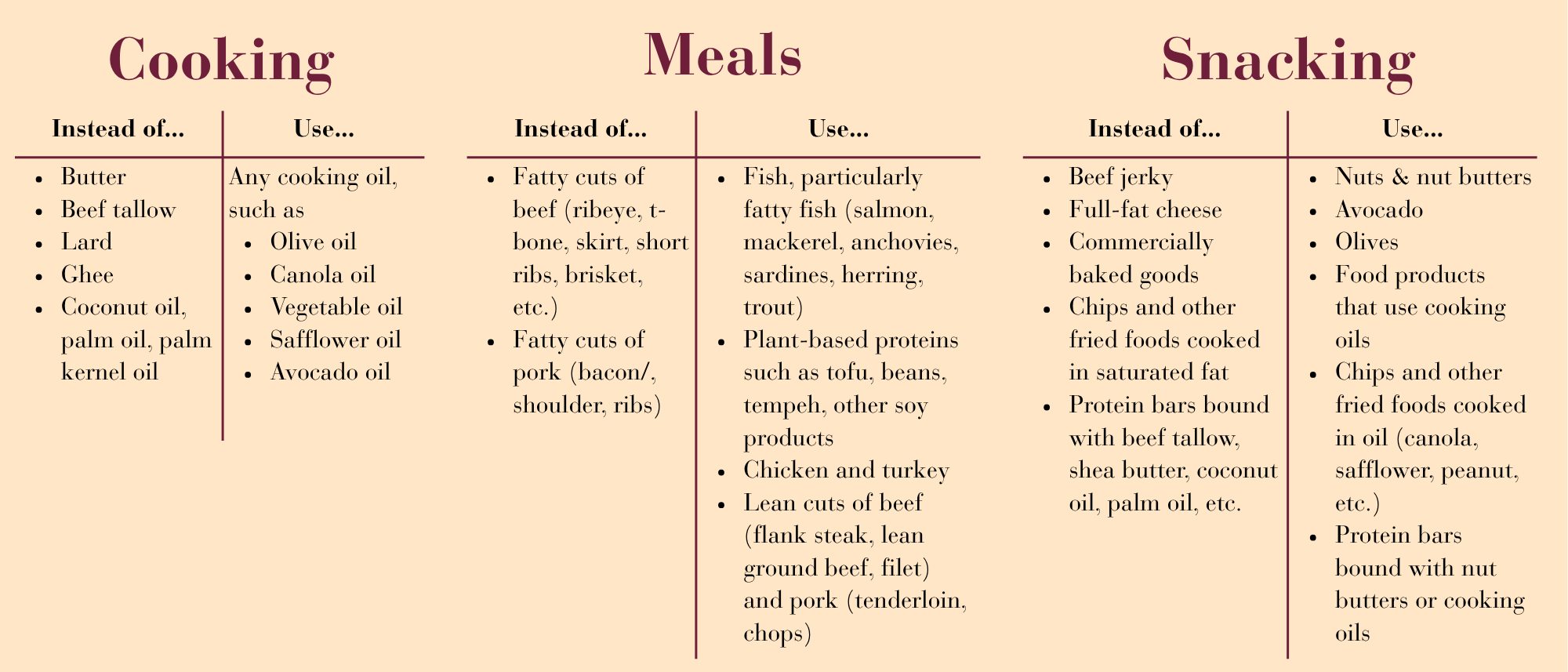
So, what does it actually look like to make choices that are supported by research, not Instagram? Here are some easy swaps:
References:
Jakobsen MU, O’Reilly EJ, Heitmann BL, et al. Major types of dietary fat and risk of coronary heart disease: a pooled analysis of 11 cohort studies. The American Journal of Clinical Nutrition. 2009;89(5):1425-1432. doi:10.3945/ajcn.2008.27124
Guasch-Ferré M, Babio N, Martínez-González MA, et al. Dietary fat intake and risk of cardiovascular disease and all-cause mortality in a population at high risk of cardiovascular disease. The American Journal of Clinical Nutrition. 2015;102(6):1563-1573. doi:10.3945/ajcn.115.116046
Wang DD, Li Y, Chiuve SE, et al. Association of Specific Dietary Fats With Total and Cause-Specific Mortality. JAMA Intern Med. 2016;176(8):1134. doi:10.1001/jamainternmed.2016.2417
Ramsden CE, Zamora D, Majchrzak-Hong S, et al. Re-evaluation of the traditional diet-heart hypothesis: analysis of recovered data from Minnesota Coronary Experiment (1968-73). BMJ. Published online April 12, 2016:i1246. doi:10.1136/bmj.i1246
Ramsden CE, Zamora D, Leelarthaepin B, et al. Use of dietary linoleic acid for secondary prevention of coronary heart disease and death: evaluation of recovered data from the Sydney Diet Heart Study and updated meta-analysis. BMJ. 2013;346(feb04 3):e8707-e8707. doi:10.1136/bmj.e8707
Chowdhury R, Warnakula S, Kunutsor S, et al. Association of Dietary, Circulating, and Supplement Fatty Acids With Coronary Risk: A Systematic Review and Meta-analysis. Ann Intern Med. 2014;160(6):398-406. doi:10.7326/M13-1788
About Women and Heart Disease. Centers for Disease Control and Prevention. May 15, 2024. https://www.cdc.gov/heart-disease/about/women-and-heart-disease.html
